“Browse uniforms, gear, equipment, and more at Brooklyn’s Coat Arcade, and look and feel like a winner next time your team hits the field.”
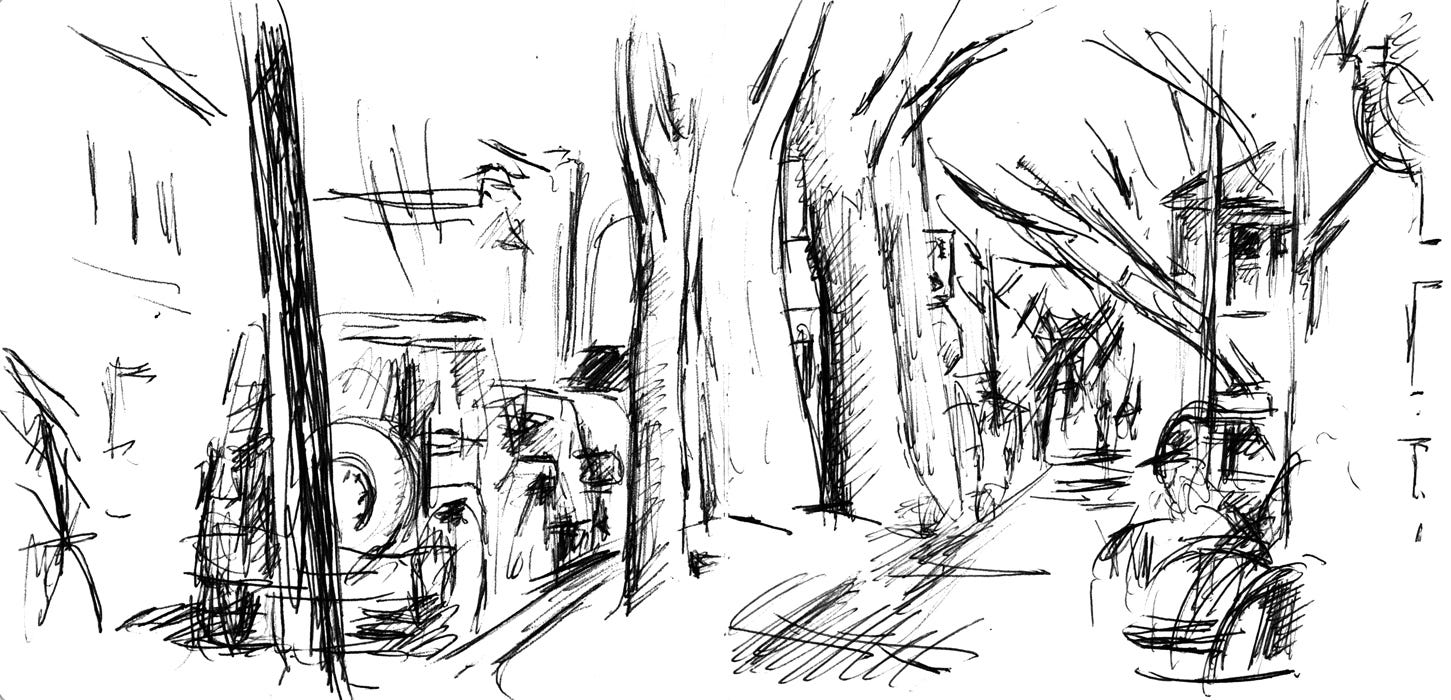
The Coat Arcade used to be on the ground floor of the apartment building I lived in in Borough Park, Brooklyn. 1805 49th Street. I was in apartment C3. I never went to the Coat Arcade though. Not sure it was even there in the fall of 1989.
I only lived there about six months, during my ill-fated first semester of art school at Parsons. I’d been trying to track down the address ever since watching a documentary about the murder of Yusef Hawkins. It had happened down the street in Bensonhurst, weeks before I moved in. I wanted to see how close I lived to the scene of the crime and the protests that followed. This was the event that cemented Al Sharpton’s place on the national stage.
I was nineteen and mostly unaware. I had my own very important issues——like avoiding my slightly insane geriatric roommate and the daily commute on the F train to Manhattan. The only thing I knew about Bensonhurst is there was a newsstand there that sold porn magazines.
I look at a Streetview scan of the building and have no memory of the doorway or any of the rest. Doubtless the storefronts have changed, but this is a brick apartment structure from 1923. How much could it have changed? It may as well be any one of a million random places I’d never even set foot in.
There’s very little online about 1805 49th Street. Some generic realtor photos, listings of former residents on for-pay reference sites, and Justo L Roman. There’s a photo of the man smiling in front of a wall of electronic gear. The picture is undated, but the form with his ham radio handle and info says 2016. No way it’s that recent. Unless that part of Brooklyn somehow remained a couple decades back.
The Coat Arcade has moved on to other locations. Not sure it’s still operational. The plague killed off so many small operations.
Somebody else will have to dress Brooklyn’s teams so they can feel like winners now.
I’m reading Olga Tokarczuk’s epic, The Books of Jacob, set in the 1700s in an area that’s now mostly Poland and Ukraine. The borders are ever-shifting, but unlike now, in that pre-industrial time, animals are ever-present in daily life.
Actual animals and ones made by art to stand in for either people or their ideas and feelings blur together sometimes. I write in my book-in-progress about a fellow art student who brought a pig head from Chinatown and painted portraits of it in a common room at school. Making a portrait of an animal, or, in this case, its severed head, divorces it both from its now-ended life as well as its place in whatever anyone could take as its natural place in the world. Now it’s no longer part of the animal kingdom——if it even ever was, since it was livestock bred to be eaten——but it’s no longer part of the food chain either. As that head sat and rotted on a table in a downtown Chicago art school the window in which it might have been consumed closed fast.
There are a million examples of amazing paintings of fish and game throughout art history. I wonder how many painters worked fast enough that they could cook their subjects for dinner after the picture was done?
I never painted a dead animal aside from memorial pet portraits. But those were from photos their grieving owners sent me. A very different kettle of fish. There are a couple ink paintings and pen drawings of the dog I had a short time I had to put him down because he had heartworms so bad the vet told me he likely wouldn’t survive the operations needed to rid him of them. Everyone but me was terrified of that guy. I still miss him sometimes though he was a handful.
Last weekend I got to catch my friend Bill play with his band, Black Duck, at Thalia Hall. Nice to see him let loose and shred in ways he usually doesn’t allow himself to. They were opening for Yo La Tengo, a band I loved in the 80s and early 90s. Last I saw them was in 1991 or 1992 at Lounge Ax. That club is long gone but they’re still at it.
I stayed for about five minutes of blissed out noodling, then biked home.
The first leg of the flight, terminating in Madrid, Spain, is uneventful. Three of its eight hours are killed by two dreadful Hollywood offerings: The Rocker starring Rainn Wilson as a middle-aged loser who lives out his dream by playing in his nephew’s rock band, followed by The Sisterhood of the Traveling Pants 2, in which young girls solve their problems with the aid of a pair of jeans bearing sparkling stars on the ass.
Madrid to Tel Aviv is more arduous. Being neighbored on three sides by yowling, slobbering, and spitting infants and their keepers doesn’t help my sleep-deprivation any. The keepers suspend their little droolers over my airspace and exchange precious memories and parenting lore as strings of saliva settle in my hair and on my clothes. I blast my iPod to diminish the assault. The horror is exacerbated as I finish reading 7 Days in the Art World, Sarah Thornton’s chilling ethnographic safari through the key outposts of an industry to which I nominally belong.
I spend the rest of the flight sketching neighboring slumberers and willing the minutes to bloom into hours.
Passport Security takes pleasure in the detailed account of my life story, including the reason why, having been born there, I do not carry Russian citizenship. Then we have to wait as my brother Boris and his girlfriend Blakeney inquire about their luggage, which was left behind by striking Alitalia workers in Rome. At their place, my mother has already laid out a feast and grandparents and other relations soon follow. My brother Max is there too, but is a shadowy presence due to a severe bout of food poisoning. He shuttles between bed and toilet mostly, then leaves to welcome the New Year with friends in Boston.
December 27th
Morning cigarettes on the balcony next to the washer, ashing over the clothes line, taking in the steep, tree-filled corner on view. Next, an excursion to King Herod’s fortress——now a collection of passageways and scattered stones on a hilltop. Visits to ruins like this are probably a pretext to conversation or bonding with one’s fellow travelers, but the climb and descent are what sticks in my memory. Also, the rolling desert landscape dotted intermittently with structures and flora like a sea of bald men’s heads with comb-overs or disintegrating toupees.
We’re told that the bombing of Gaza by the Israeli army has begun. The only immediate effect for us is that the planned excursion to Petra in Jordan is canceled. The endless bloodletting over this godforsaken strip of land has always been a mystery to me. More intelligent tribes long ago moved to territories more conducive to habitation. Yet the pull of ancient mythology and perceived ancestry keeps fanning the flames here. Having been to this country six or seven times now, there’s no sense in which this feels like home to me. But I know many others feel differently.
A walk through the Old City with my father, Boris, and Blakeney includes the Wailing Wall and the Church of the Holy Sepulchre, built on the spot where Jesus was crucified and monks of competing denominations now enjoy punching each other in the face. It is a rabbit warren of alcoves containing icons, crosses, and other Christian bric-a-brac, fawned over by packs of tourists and desecrated by the graffiti of true believers. Boris and Blakeney document this and other sites on various digital devices, while my father runs ahead and I try to keep them all within sight.
December 28th
Boris and Blakeney leave for a restorative trip to a Dead Sea spa. I turn down proposals of sightseeing and work on a watercolor on the back porch. Tracking the path of the sun in this quiet corner is probably perverse while the bombs fall a few miles way, as strangely remote as the Iraq war back home, but present as an undercurrent nonetheless. Painting does bring me back to what passes for normalcy, removing the dislocating sensation of travel.
A mad search for a certain bakery located in an industrial block——the rolling racks of fresh-baked loaves the only clue among poured concrete structures, dumpsters, and loading docks. Then to my grandparents house in the evening to celebrate their 64th wedding anniversary. An hour perusing old photo albums is followed by the setting of silverware, plates, and food. Then toasts to health and future and family and past, then home.
December 29th
We head south, picking up the mud bathers on the way, en route to Eilat. The ever-shrinking Dead Sea accompanies us for half the trip, visible to the left of the road, then tapers to nothing. The two-lane highway through the rolling desert makes for sometimes hairy moments as over-enthusiastic motorists pass within feet of oncoming traffic. Hairpin turns and undulating hills make visibility short-lived and sporadic.
Our destination is a resort town on the Red Sea, in the southern tip of the country, bordered by Egypt and Jordan. Having made dinner plans with a distant relative also staying in town, we circle about the hotels, restaurants, parking lots, and bridges to nowhere until a helpful cabbie finally sets us straight. At the table, Russian, English, and French mixes to sometimes jell into conversation. I opt out and doodle in my sketchbook instead. The stroll along the boardwalk brings a bombardment of neon, cheap tchotchkes, and signage in Hebrew, English, Arabic, and Russian. Promenading families, couples, and packs of teens compete for purchase on the path with hucksters and street musicians. The most notable is a fat Russian emigré in a white suit who enthusiastically puts his whole body into renditions of smooth jazz standards on saxophone and clarinet backed by a karaoke machine. The overall effect of the place is a sad mix of Coney Island and Atlantic City with clashing cultures as seasoning. Seedy, yet redolent of elusive thrills and forgotten joy.
Thrifty, as always, we sleep five in one room. I’m on the kiddie cot with the lights out, not ready to sleep or listen to my brother fart in his slumbers. Blakeney proactively purchased earplugs against my own operatic snoring. I wander out into the night instead. A cinderblock box building covered in neon liquor ads wheezes out disco beats to the expectant line of teens waiting to enter, while a strip club, Irish bar, and fast-food shack lonesomely await patronage. I think about coffee but return to the hotel and sit in the lobby reading for a while before going back to the room.
December 30th
The breakfast buffet, included in the price of the room, ends at 10:30 am so we hurry to shovel in eggs, potatoes, coffee, and cereal among our fellow vacationists. The hotel is made up of three buildings in the shape of ocean liners with swimming pools in between, decorated with faux rock formations, palm trees, and paper maché birds and lizards worthy of Rainforest Cafe. A mini soccer field attracts little boys and their fathers in sweatpants, who occasionally play for real, but are for the most part content to knock the ball back lazily to their offspring.
Enthralled by this grandeur, I beg off the planned excursion to an ancient Egyptian site and stay on the balcony, attempting to capture some tiny sliver of the majesty before me.
I wait for my family in the lobby among the lingerers, web surfers, and wailing children. They return bearing shawarma sandwiches and we commiserate about what to eat next, between mouthfuls of lamb and tahini.
Dinner is at a place away from the main drag, past the harbor housing miles of recently delivered cars, across the street from a Club Med, on the last bit Israeli land before the border with Egypt. Then, a meeting with our elderly relative in the lobby of the Hilton, which also houses loungers, but of a decidedly more calcified vintage.
December 31st
We head back to Jerusalem in the morning, with a detour to a historic site set high in the mountains, right next to nowhere. A harsh corkscrew of a climb leads to a plateau, past barbed-wire-fenced military installations and an oddly solitary factory, to a pile of rocks beyond a guard booth where our wallets are lightened slightly for the privilege of entry. A town once stood here, now partially reconstructed, but mostly a pile of once-used boulders. Some bits of mosaic have survived, but the rest is quite obviously recreated, leading me to wonder whether this is a view of history in any way different than a Civil War reenactment. What certainly is history is the adjoining cafe. A distant memory, judging by the view through its dusty windows.
After a forty minute wait approaching a checkpoint, we’re back in Jerusalem to greet the coming of the new year. The apartment fills with family arriving to eat and drink together. I drowsily and reluctantly joined in. My lifelong inability to engage in group revelry is probably exacerbated by being half awake. But soon another celebration has passed and it is time to clear dishes again. This is my favorite part of any gathering.
January 1st
My flight leaves at 6 am but both mother and father insist on seeing me off, so we set out for Tel Aviv at 3:30. The check-in is going smoothly until I get to the Iberia counter, where I’m told that in the five days since the trip in, the airplanes have apparently shrunk. Now my carry-on bag, which hadn’t rated a second look in Chicago or Madrid, is judged oversized and has to be checked.
The return trip is mercifully uneventful. Besides the bandy-legged little man next to me, who insists on invading my leg room with his thighs, even the in-flight movies are better——Appaloosa with Ed Harris and Ghost Town with Ricky Gervais, which is sappy but still preferable to attempting sleep in coach. The best part of air travel has always been getting off, which can also be said of travel in general.
Coming back is the only thing that makes vacations bearable.